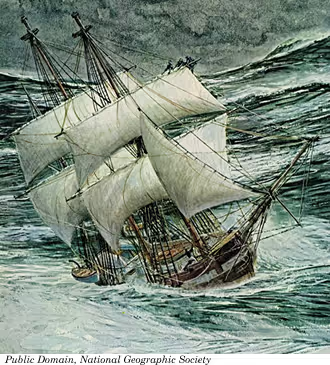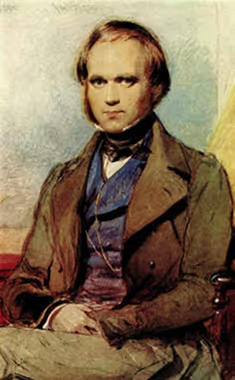



I HAVE stated in the preface to the first Edition of this work, and in the Zoology of the Voyage of the Beagle, that it was in consequence of a wish expressed by Captain FitzRoy of having some scientific person on board, accompanied by an offer from him of giving up part of his own accommodations, that I volunteered my services which received, through the kindness of the hydrographer, Captain Beaufort, the sanction of the Lords of the Admiralty. As I feel that the opportunities which I enjoyed of studying the Natural History of the different countries we visited have been wholly due to Captain FitzRoy, I hope I may here be permitted to repeat my expression of gratitude to him, and to add that, during the five years we were together, I received from him the most cordial friendship and steady assistance. Both to Captain Fitz Roy and to all the Officers of the Beagle[10] I shall ever feel most thankful for the undeviating kindness with which I was treated during our long voyage.
This volume contains, in the form of a Journal, a history of our voyage, and a sketch of those observations in Natural History and Geology, which I think will possess some interest for the general reader. I have in this edition largely condensed and corrected some parts, and have added a little to others, in order to render the volume more fitted for popular reading; but I trust that naturalists will remember, that they must refer for details to the larger publications which comprise the scientific results of the Expedition. The Zoology of the Voyage of the Beagle includes an account of the Fossil Mammalia, by Professor Owen; of the Living Mammalia, by Mr. Waterhouse; of the Birds, by Mr. Gould; of the Fish, by the Rev. L. Jenyns; and of the Reptiles, by Mr. Bell. I have appended to the descriptions of each species an account of its habits and range. These works, which I owe to the high talents and disinterested [unbiased] zeal of the above distinguished authors, could not have been undertaken, had it not been for the liberality of the Lords Commissioners of Her Majesty's Treasury, who, through the representation of the Right Honourable the Chancellor of the Exchequer, have been pleased to grant a sum of one thousand pounds towards defraying part of the expenses of publication.
I have myself published separate volumes on the 'Structure and Distribution of Coral Reefs;' on the 'Volcanic Islands visited during the Voyage of the Beagle;' and on the 'Geology of South America.' The sixth volume of the 'Geological Transactions' contains two papers of mine on the Erratic Boulders and Volcanic Phenomena of South America. Messrs. Waterhouse, Walker, Newman, and White, have published several able papers on the Insects which were collected, and I trust that many others will hereafter follow. The plants from the southern parts of America will be given by Dr. J. Hooker, in his great work on the Botany of the Southern Hemisphere. The Flora of the Galapagos Archipelago is the subject of a separate memoir by him, in the 'Linnean Transactions.' The Reverend Professor Henslow has published a list of the plants collected by me at the Keeling Islands; and the Reverend J. M. Berkeley has described my cryptogamic plants.
I shall have the pleasure of acknowledging the great assistance which I have received from several other naturalists in the course of this and my other works; but I must be here allowed to return my most sincere thanks to the Reverend Professor Henslow, who, when I was an undergraduate at Cambridge, was one chief means of giving me a taste for Natural History,— who, during my absence, took charge of the collections I sent home, and by his correspondence directed my endeavours,— and who, since my return, has constantly rendered me every assistance which the kindest friend could offer.
DOWN, BROMLEY, KENT,
June 9, 1845

[10] I must take this opportunity of returning my sincere thanks to Mr. Bynoe, the surgeon of the Beagle, for his very kind attention to me when I was ill at Valparaiso.