


About Charles Darwin
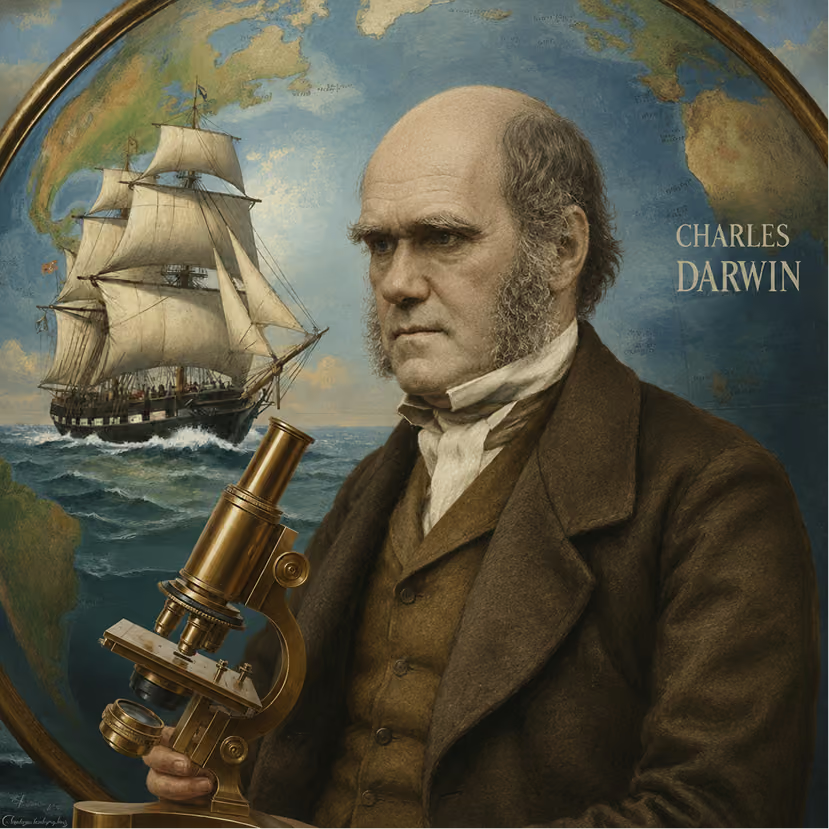
How did a curious, relatively unknown young man of 22, fueled by a deep love of natural science, become, in just five years, one of the greatest scientists in modern history, advancing natural science out of the Dark Ages, from medieval religious views to the foundation of almost boundless scientific knowledge we have today?
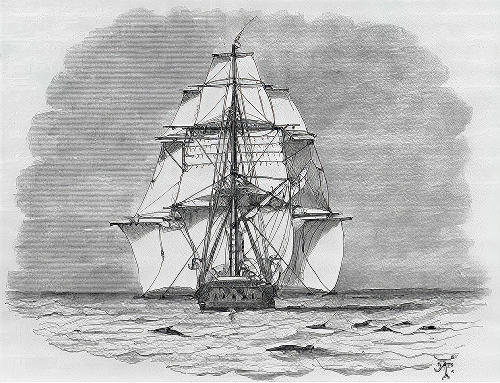
In “The Voyage of the Beagle,” he shares observations and stories from his five-year trip around the world in the 1800s. Darwin discusses the discoveries that supported his own ideas and those of leading scientists of the time. These adventures encouraged him to think analytically about questions that led to concepts of long evolutionary eras and continental drift, eventually supporting the theories of evolution by natural selection and plate tectonics, among others. His eventual explanation of the evolutionary process in his later book “On the Origin of Species” forms the basis of modern-day biological sciences, including agriculture, medicine, and biotechnology.
Darwin's love affair with nature dominated his life. His effort to understand life became the thread that held his existence together.
“Visualizing" the Voyage
Visual Voyage of the Beagle is an eBook reissue of Charles Darwin's "Voyage of the Beagle," divided into its original chapters, with some chapters subdivided into two or three parts to aid readability.
The eBook is structured as a website with a split-screen format we call a "web-book," allowing scrolling text on the left and scrolling graphics on the right, making visual references available without flipping pages or opening other books.
The founders of Visual Historian Publishing consider that a clear re-enactment of past events should include both visual and textual portrayals. We believe maps, charts, images, and photographs that accompany the text contribute to readers' overall knowledge of the subject and the story's believability.
Darwin's text remains unchanged from that of the original issues. Still, because 1850s punctuation can confuse modern readers, we altered some original punctuation for clarity. Locations referenced are spelled and pronounced as when Darwin published his book in the mid-nineteenth century. However, where referenced in the eBook's graphics and images outside Darwin's text, we use the locations' current names. Also, the editor's explanatary notes inserted into the original text are shown italicized within brackets.
The primary objective of this work is to increase the readability and understanding of a work authored in 1850s England by a budding scientist rather than a work of a literary figure. Our development of this "web-book" concept, though not as lucid as a motion picture, is a modest step in that direction.